

In the travel and rental industry, few terms carry as much weight or confusion as “Unlimited Mileage Or Unlimited Miles” For a customer standing at the rental counter, it sounds like a golden ticket to absolute freedom: a license to drive to the horizon and back without a single worry. But for industry insiders and savvy travellers, the phrase often triggers a reflex to check the fine print.
Does “unlimited” really mean you can drive a rental sedan from Alaska to Argentina? Usually, no. As we dissect this concept, we uncover a fascinating balance between marketing psychology, fleet depreciation mechanics, and the hard realities of rental contracts. Whether you are a renter planning a grand tour or a business owner protecting your assets, understanding the nuances of mileage caps is essential for your wallet and your peace of mind.
The Allure of the Open Road
When you book a rental car, you typically face a binary choice: a plan with a mileage cap or a plan with unlimited miles. The latter is the industry standard for most major rental chains in the United States, and for good reason. It removes a significant psychological barrier for the customer.
With unlimited mileage, the odometer becomes irrelevant to the final price. You pay a daily rate, and whether you drive 5 miles to a meeting or 500 miles to a national park, the bill remains the same. This simplicity is a powerful selling point. It eliminates the “taxi meter effect,” where a passenger watches the cost tick up with every mile, creating anxiety rather than enjoyment.

Unlimited vs. Limited: The Mechanics of the Deal
To understand the value of unlimited miles, you must first understand the alternative. Limited mileage plans usually cap your driving at a specific number often 100 to 150 miles per day. If you rent the car for three days, you get 450 miles total.
The danger lies in the “overage fee.” If you exceed that cap, the penalty is steep, often ranging from $0.25 to $0.50 per mile. Driving just 100 miles over your limit could add $50 to your bill instantly.
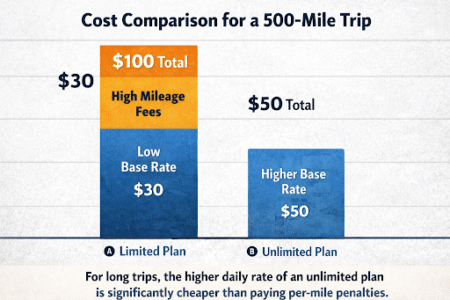
Cost comparison
The “Fine Print”: When Unlimited Isn’t Unlimited
Here is where the reality check comes in. “Unlimited” refers to the distance you can drive, but it almost always comes with strict boundaries regarding location and vehicle type. Breaking these rules doesn’t just incur a fee; it often voids your rental contract and insurance, leaving you personally liable for the vehicle.
1. Geographic Restrictions (The Invisible Fence)
Unlimited mileage rarely applies globally. Most contracts restrict the vehicle to the country of rental or specific bordering regions.
- State Lines: Smaller, independent rental agencies often offer unlimited miles only if you stay within the state. Cross the state line, and the contract reverts to a per-mile charge for the entire trip.
- International Borders: Taking a US rental car into Mexico or Canada often requires specific permission and insurance riders. Without them, “unlimited miles” means nothing because you are driving an unauthorized vehicle.
2. Vehicle Tier Exclusions
Rental companies protect their most valuable assets. You will rarely find unlimited mileage on:
- Exotic Cars: A Ferrari or Porsche loses value rapidly with every mile. These rentals almost always have strict caps (e.g., 50 miles/day).
- Commercial Trucks: Moving vans and cargo trucks endure heavy wear. Offering unlimited miles on these encourages commercial misuse, so companies cap them to ensure the vehicle is used for a specific move, not a cross-country logistics run.
3. Duration Limits
If you rent a car for a month or longer (a “mini-lease”), the unlimited clause often expires. The company might cap you at 2,500 or 3,000 miles per month to prevent you from using the car as a high-mileage courier vehicle.

Duration limit
Why Do Companies Offer It? The Business Perspective
You might wonder why a rental company would allow a customer to put 2,000 miles on a car for a $40 daily fee. The answer lies in data and averages.
- Fleet Utilization: Cars only make money when they are rented. Unlimited mileage attracts more customers, ensuring the fleet isn’t sitting idle.
- The Average Driver: Rental companies use sophisticated fleet management software. They know that for every “road warrior” who drives 2,000 miles, ten other corporate travelers will only drive 50 miles from the airport to a hotel. The low-mileage drivers subsidize the high-mileage ones.
- Resale Value: Modern cars last longer. A rental car with 40,000 miles still holds significant resale value, meaning the depreciation cost of “extra” miles is lower than it used to be.
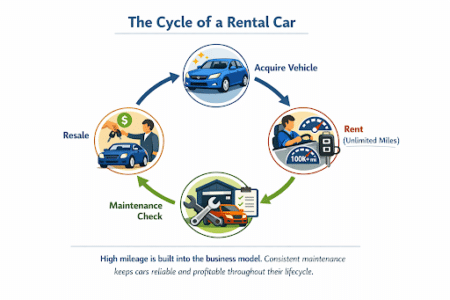
Cycle of rental car
Who Should Choose Unlimited Mileage?
Making the right choice depends entirely on your itinerary.
- The Road Tripper: This is non-negotiable. If your plans involve scenic detours or multiple cities, unlimited mileage is your insurance policy against unexpected costs.
- The Business Traveller: If your schedule is fluid—client meetings might move, or you might need to visit a factory two hours away—unlimited miles provide the flexibility you need.
- The One-Way Renter: Moving from City A to City B usually requires unlimited miles, though one-way rentals often come with a separate “drop fee.”
However, if you are simply flying in, driving to a resort, and parking for a week, a limited mileage plan (if available) could save you money on the daily rate.
Conclusion
“Unlimited mileage” is a feature designed for peace of mind, but it is not a magic wand. It is a specific contractual term with boundaries. By understanding the geographic and vehicle specific limitations, renters can enjoy the open road without fear of the final bill. For rental business owners, offering this perk is a calculated risk that, when managed with the right software and maintenance schedules, drives customer loyalty and fleet profitability.
